Components / Resistors

Resistors: Types, Ratings and Uses

Learn how resistance, tolerance, power and temperature ratings affect a real circuit.

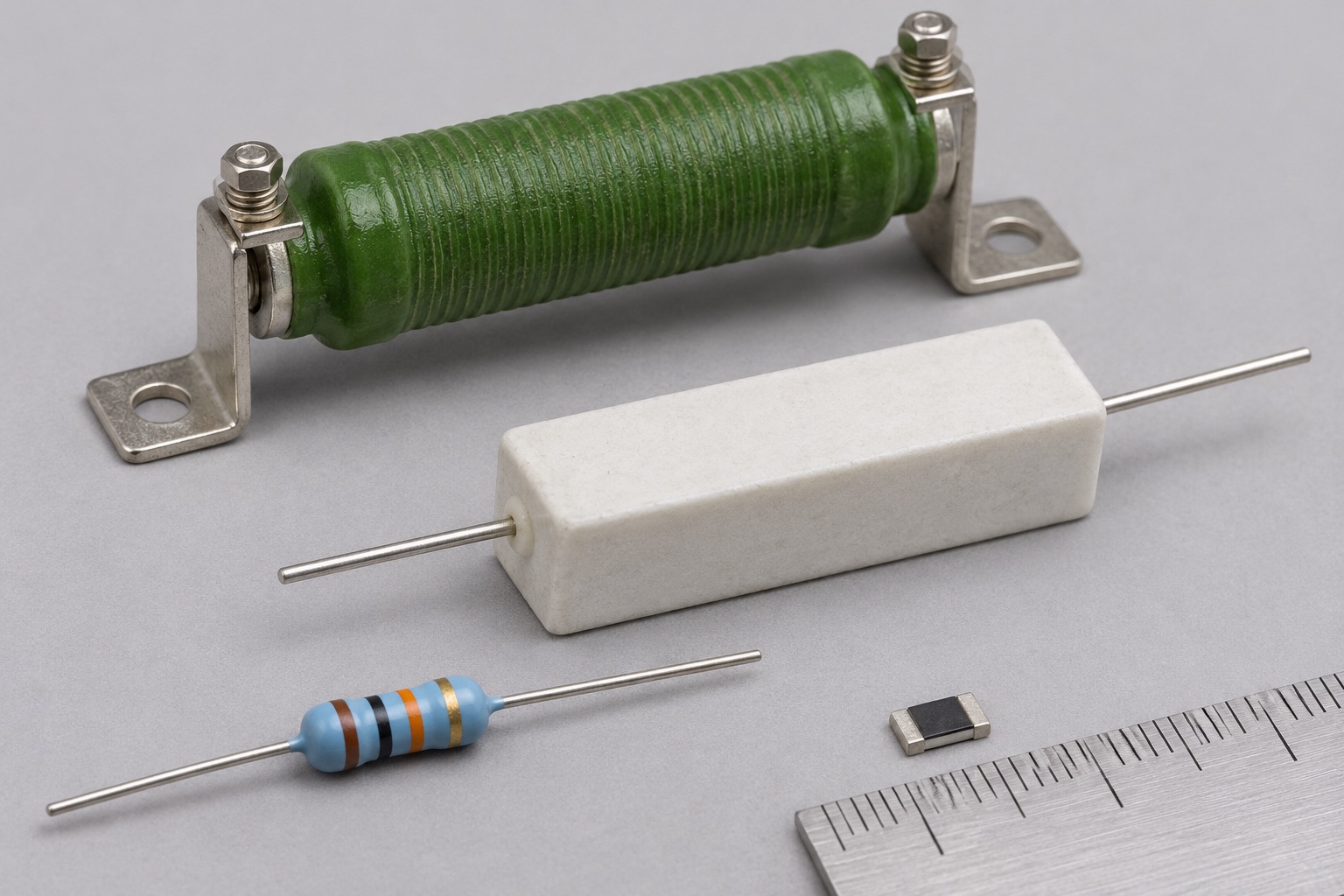
Illustrated physical resistor forms: large enamelled power resistor, white cemented power resistor, blue axial resistor and tiny surface-mount chip
Appearance illustration of 3 common physical forms. Generated for teaching, not a photograph of the models below; size and markings are not exact. See the in-site model notes for verified details.

Recognise and choose

What forms will you encounter?

01Blue part, lower left

Axial leaded film resistor

How to recognise it
Small cylinder with one lead at each end and colour bands or printed markings.
Use it when
Breadboard experiments, through-hole PCBs and repair where hand soldering matters.
Check before choosing
Resistance, tolerance, power derating and maximum working voltage.

Model notes on this siteVishay MRS25 →

02Tiny black part, lower right

Surface-mount chip resistor

How to recognise it
Flat rectangular chip with metal terminations at both ends; very small values may be unmarked.
Use it when
Compact or machine-assembled PCBs; the same circuit function in less board space.
Check before choosing
Metric versus imperial package code, value, tolerance and power on the actual board.

Model notes on this siteVishay CRCW0603 →

03Large green and white parts

Cemented or enamelled wirewound resistor

How to recognise it
A much larger ceramic or enamelled body; some power versions have a metal housing for mounting to a heatsink.
Use it when
Loads, braking or other circuits that must dissipate more heat than a small film resistor.
Check before choosing
The power rating depends on ambient temperature and mounting; check pulse energy and inductance where relevant.

Model notes on this siteVishay AC series →Vishay RH series →

At a glance

A fixed resistor limits current, develops a voltage drop or forms a divider. The printed value is nominal; heat and tolerance determine whether it fits the job.

This guide explains a component family. Check the exact part number and manufacturer datasheet before building.

Key specifications

Resistance
Nominal value in ohms (Ω)
Tolerance
Allowed initial spread from the nominal value
Rated power
Dissipation limit under specified mounting and temperature
Temperature coefficient
Resistance change with temperature, often in ppm/K

Circuit Lab

Put this component into a circuit

How do resistance and load change current, voltage and heat?

Change
Supply voltage, resistance, tolerance and load
Observe
Current, voltage drop and dissipated power
Try a related tool →

Explore the linked experiments using their stated model assumptions. Device-specific limits still come from the linked datasheets.

How it works

For an ideal DC resistor, V = I × R and P = I²R = V²/R. A series resistor limits current only when the supply, load voltage and resistor are considered together. In a divider, any connected load changes the effective lower resistance.

Types and construction

Metal film parts are common where accuracy and low noise matter; thick film chip resistors are compact and widely used; wirewound parts can handle more power but may have appreciable inductance. Construction alone does not establish a rating: compare actual series data.

Worked example

A 1 kΩ resistor across 5 V carries 5 mA and dissipates 25 mW. A 10 kΩ + 10 kΩ divider on 5 V gives 2.5 V unloaded; adding a 10 kΩ load across the lower resistor reduces the output to about 1.67 V.

Reading a datasheet

Check resistance range, tolerance, rated power and its derating curve, maximum working voltage, temperature range and any pulse rating. Surface mount power ratings depend on PCB copper and test conditions.

Common mistakes

  • Treating the nominal resistance as an exact measured value.
  • Ignoring power derating or applying a wattage rating under different mounting conditions.
  • Using an unloaded divider equation after attaching a significant load.

Explore further

Source and review

Reviewed 18 November 2026 against Vishay, Basics of Linear Fixed Resistors. Examples are simplified educational models; ratings and pinouts depend on the exact device.