Components / MOSFETs

MOSFETs: Gate Drive and Key Parameters

Distinguish gate threshold from full enhancement and check switching losses.

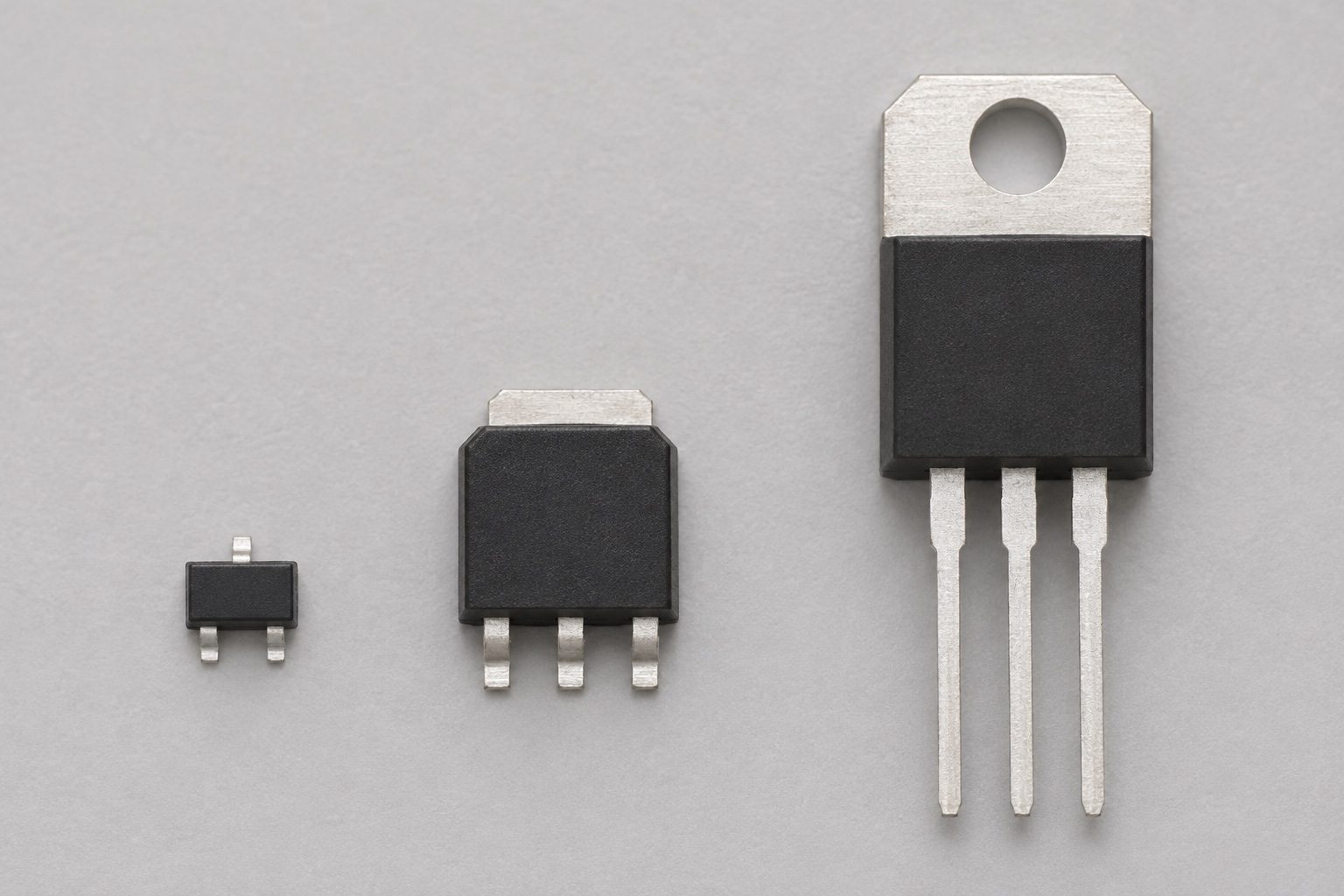
Illustrated MOSFET packages: tiny SOT-23 at left, surface-mount DPAK in the centre and larger through-hole TO-220 at right
Appearance illustration of 3 common physical forms. Generated for teaching, not a photograph of the models below; size and markings are not exact. See the in-site model notes for verified details.

Recognise and choose

What forms will you encounter?

01Tiny three-terminal package, left

SOT-23 small-signal MOSFET

How to recognise it
Small flat three-terminal package that looks similar to a SOT-23 BJT.
Use it when
Low-current load switching or level shifting on compact PCBs.
Check before choosing
Gate voltage, RDS(on) at that voltage, pinout and body-diode direction.

Model notes on this siteDiodes Incorporated BSS138 →

02Large tabbed package, right

TO-220 power MOSFET

How to recognise it
Three leads and a metal mounting tab; a TO-220 BJT can have the same exterior.
Use it when
Larger switched loads when gate drive and cooling are designed together.
Check before choosing
Read the part marking and model-specific Gate–Drain–Source pin diagram; also check RDS(on) at actual VGS, gate charge and heat.

Model notes on this siteInfineon IRLZ44N →

03Flat tabbed PCB package, centre

DPAK / TO-252 power MOSFET

How to recognise it
Surface-mount body with a broad metal heat tab soldered to PCB copper.
Use it when
Power switching on production PCBs where copper area provides the thermal path.
Check before choosing
Drain-tab footprint, copper-dependent thermal rating, gate drive and losses.

Model notes on this siteInfineon IRLR7843 →

At a glance

A MOSFET controls drain-to-source current using gate-to-source voltage. Gate threshold only marks the start of conduction at a small test current.

This guide explains a component family. Check the exact part number and manufacturer datasheet before building.

Key specifications

VDS
Maximum specified drain-source voltage
ID and thermal limits
Current capability depends on package and cooling
RDS(on)
On-resistance at a stated VGS and temperature
VGS(max) and gate charge
Gate-voltage limit and switching-drive demand

Circuit Lab

Put this component into a circuit

Why does gate threshold not tell us whether a MOSFET is fully on?

Change
VGS, load current, RDS(on) point and switching rate
Observe
Conduction loss, gate-drive demand and temperature sensitivity

This describes a learning model for a future experiment. Device-specific limits still come from the linked datasheets.

How it works

An N-channel enhancement MOSFET can act as a low-side switch. Its gate draws little steady DC current but must be charged and discharged during switching. The body diode conducts in one direction even when the channel is off.

Types and construction

N-channel and P-channel devices use different gate polarities. “Logic level” is a useful label only when RDS(on) is specified at the actual available gate voltage. Power packages and PCB copper strongly affect thermal performance.

Worked example

If a particular MOSFET is specified at RDS(on) = 0.10 Ω for VGS = 4.5 V, then 0.5 A DC produces an idealized 25 mW channel conduction loss (I²R). Recheck RDS(on) at hot temperature, switching loss and package thermal limits before using the result.

Reading a datasheet

Compare VDS margin, maximum VGS, RDS(on) at the available gate drive, total gate charge, body-diode data, safe operating area and thermal resistance. VGS(th) is measured at a small specified drain current and is not a full-on guarantee.

Common mistakes

  • Choosing a MOSFET from VGS(th) alone.
  • Exceeding the gate-to-source maximum while trying to lower on-resistance.
  • Ignoring gate charge, body-diode direction or heat at the real switching frequency.

Explore further

Source and review

Reviewed 18 November 2026 against Texas Instruments, Avoid Common Mistakes When Selecting and Designing With Power MOSFETs. Examples are simplified educational models; ratings and pinouts depend on the exact device.