Understand the wiper, taper, total resistance and power limits.
How it works
With a high-impedance output load, the wiper of a linear potentiometer produces a fraction of the end-to-end voltage. Loading the wiper changes that fraction. As a two-terminal rheostat, the wiper contact carries load current and may need a different rating check.
Types and construction
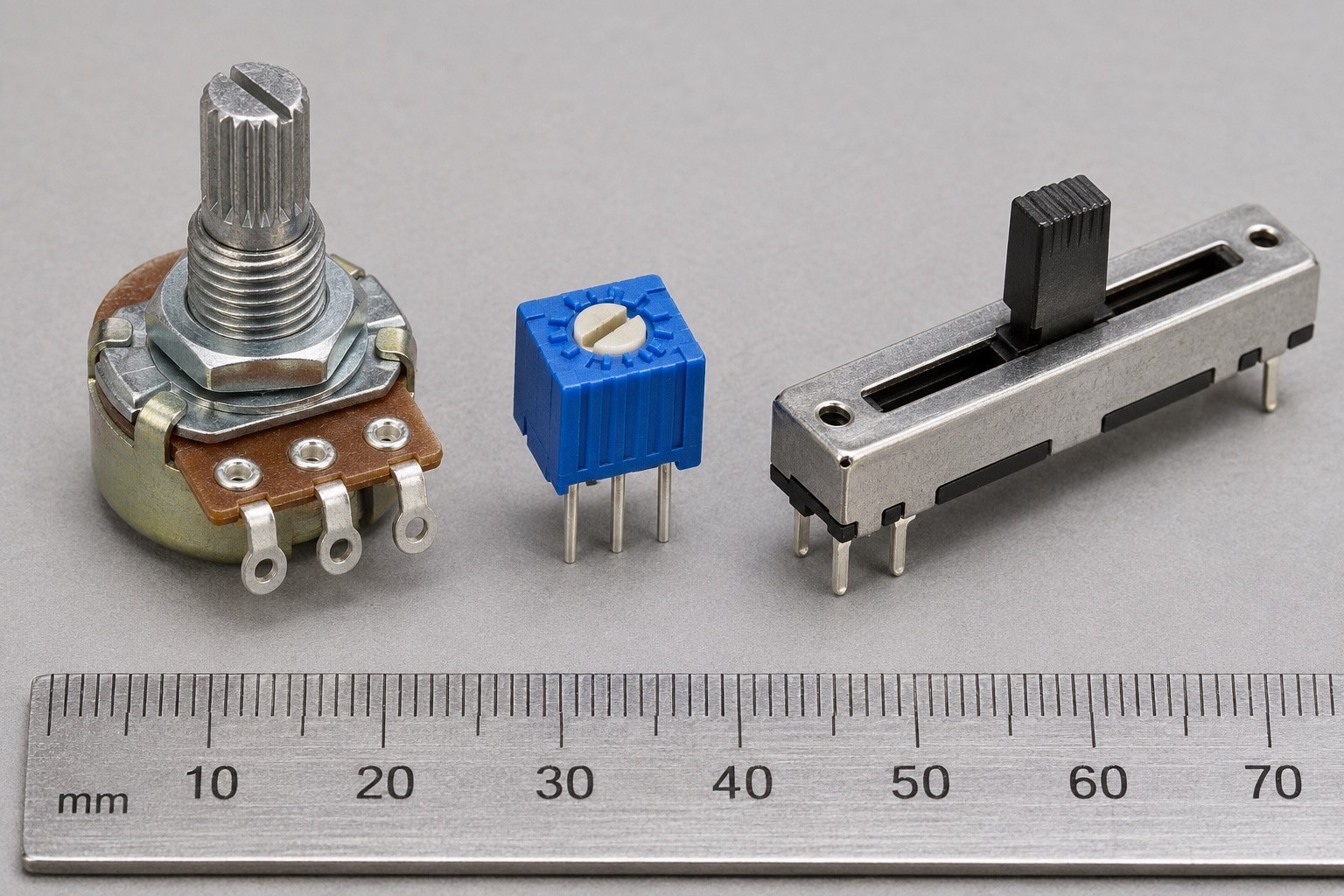
Panel controls, trimmers and digital potentiometers serve different adjustment needs. Mechanical devices vary in taper, rotational life, sealing and power. A digital potentiometer has additional supply and terminal-voltage limits.
Worked example
A 10 kΩ linear potentiometer across an ideal 5 V supply draws 0.5 mA and dissipates 2.5 mW end-to-end. At its midpoint the unloaded wiper is approximately 2.5 V; a low-resistance load will pull that voltage away from 2.5 V.
Reading a datasheet
Read total resistance tolerance, taper, power derating, maximum wiper current, end resistance, mechanical life and terminal labeling. A full-element power rating does not automatically permit the same current through every short wiper segment.
Common mistakes
- Assuming midpoint voltage stays exact after attaching a load.
- Using an audio taper as if position-to-voltage were linear.
- Ignoring the wiper-current or partial-track power limit.
Explore further
Source and review
Reviewed 18 November 2026 against Bourns, Potentiometer Handbook. Examples are simplified educational models; ratings and pinouts depend on the exact device.